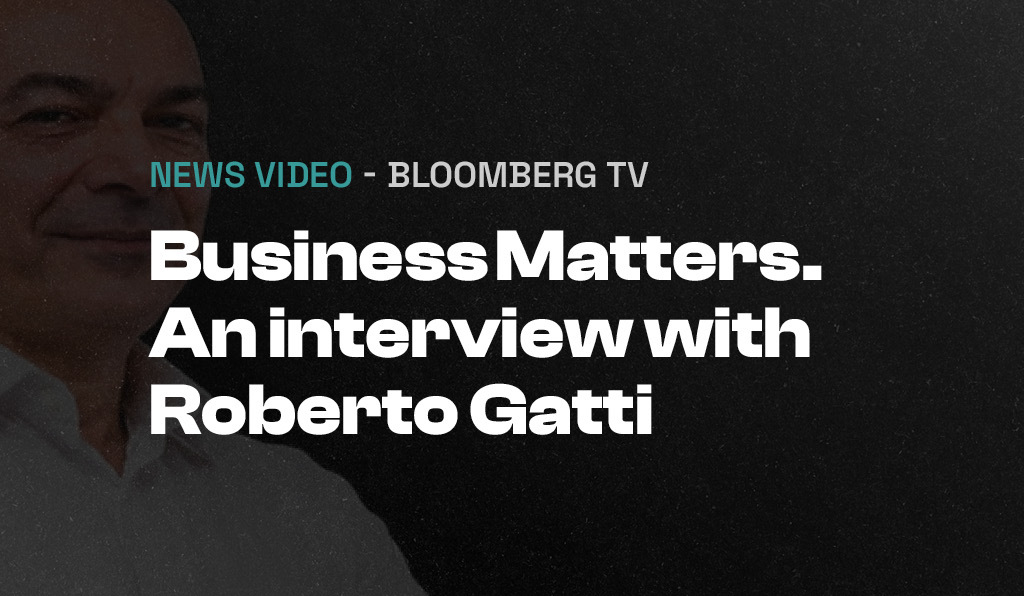
Roberto Gatti, founder and CEO of Delvitech, discusses Physical AI, automated optical inspection, and the future of the manufacturing sector.
In this episode of “Business Matters”, a Bloomberg TV segment dedicated to CEOs, the guest is Roberto Gatti, CEO and founder of Delvitech. The episode focuses entirely on the future of industrial manufacturing.
Products are increasingly reliant on electronic components, sensors, and autonomous systems. How, then, can manufacturers produce them on a large scale while ensuring the necessary precision and reliability? These are some of the topics discussed with host Juliette Foster.
From the Tesla Roadster to the production line: what do they have in common?
The recent showcase of the Tesla Roadster, which made headlines worldwide, demonstrates the limits to which experimental engineering can be pushed. Yet, it also raises a broader question: how can a prototype be transformed into a product that can be manufactured reliably?
According to Roberto Gatti, the Roadster illustrates what can be achieved when electronics, sensors, computing power, and software are designed in an integrated manner. The same principle applies to machinery used for automated optical inspection:
“We chose to build around AI from the beginning, because adding it at the end would not give us the same system.”
Roberto Gatti, Founder and CEO of Delvitech
Beyond Physical AI: AI-native.
What does all this have to do with the factory and its production methods? “Physical AI” integrates hardware, software, and data into a single system capable of understanding and making decisions on an industrial scale. The starting point is inspection: the phase where artificial intelligence meets the actual product. Its task is to translate the evidence gathered from the product into a decision regarding its quality. An AI-native architecture holds an advantage over competitors that are merely “add-ons.”
The discussion also covers the pressures facing automotive manufacturers as they grapple with electrification, “software-defined vehicles,” and increasingly advanced driving functions.
Finally, there is the cost of quality: a defective unit has already consumed materials, energy, machine time, and skilled labor. False alarms incur an additional cost, as personnel must be brought in to inspect products that were, in fact, already compliant.
The interview also addresses topics such as traceability, liability in the event of a product failure, and how the know-how acquired in one facility can be leveraged in another.
People and machines
On people and machines, Roberto Gatti says:
“The objective is not an empty factory. It is a factory that wastes less human intelligence.”
Skilled individuals should spend less time on repetitive checks and more time on diagnostics, process improvement, and making decisions that a system cannot handle on its own. As he emphasizes at the end of the interview, while the technology itself may be complex, the customer’s work should become simpler.